
Table of Contents
ToggleIntroduction
Modern heavy-duty machinery depends on components that can withstand extreme forces while maintaining smooth rotational movement. One such critical component is the slewing ring bearing. Designed to handle combined axial, radial, and moment loads, slewing ring bearings are widely used in cranes, wind turbines, excavators, and industrial equipment.
In this blog, we explain how slewing ring bearings manage multiple load types simultaneously, their internal working principles, and why high-quality manufacturing from trusted brands like Millennium Rings is essential for long-term performance.
What Is a Slewing Ring Bearing?
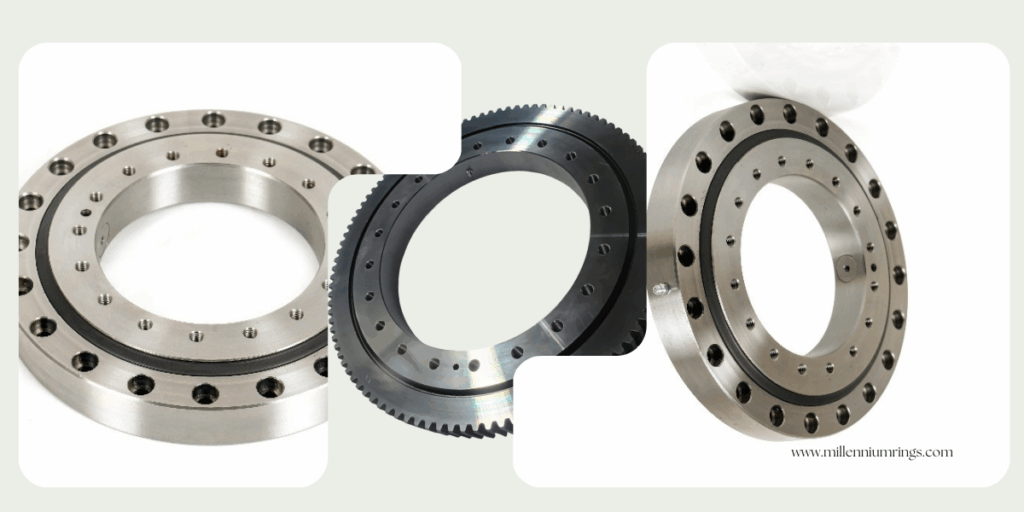
A slewing ring bearing (also known as a slewing bearing or turntable bearing) is a large-diameter bearing that allows rotational movement between two structures while supporting heavy loads. Unlike standard bearings, slewing rings are engineered to carry axial loads, radial loads, and overturning moments at the same time.
At Millennium Rings, slewing ring components are engineered using advanced forging and machining techniques to ensure high load capacity, durability, and dimensional accuracy.
Understanding the Three Types of Loads
To understand how slewing ring bearings work, it’s important to know the forces acting on them.
Axial Load
Axial load acts parallel to the bearing axis. In applications like cranes or lifting platforms, the weight of the structure and load being lifted creates significant axial force.
Examples:
- Crane superstructure weight
- Vertical loads in wind turbines
Radial Load
Radial load acts perpendicular to the bearing axis. This load is typically caused by horizontal forces during operation or movement.
Examples:
- Wind pressure on turbine blades
- Side forces during excavation
Moment Load (Overturning Load)
Moment load is generated when forces create a tilting effect on the bearing. It is the most critical load type and often determines the bearing’s design and size.
Examples:
- Extended crane booms
- Uneven load distribution
How Slewing Ring Bearings Handle Combined Loads
Slewing ring bearings are uniquely designed to distribute multiple forces efficiently across rolling elements and raceways.
- Optimized Raceway Geometry
The internal raceways of slewing bearings are precisely machined to evenly distribute axial, radial, and moment loads. This prevents stress concentration and enhances fatigue life.
At Millennium Rings, forged rings ensure superior grain flow, resulting in stronger and more durable raceways.
- Rolling Element Configuration
Depending on application requirements, slewing ring bearings may use:
- Ball bearings
- Cylindrical rollers
- Crossed roller arrangements
Crossed roller designs are particularly effective for handling high moment loads while maintaining rigidity.
- Load Distribution across Multiple Rows
Many slewing bearings feature double-row or three-row designs, allowing each row to handle a specific load type:
- One row for axial load
- One row for radial load
- One row for moment load
This separation significantly improves load capacity and operational stability.
- Forged Ring Strength & Material Quality
The performance of a slewing ring bearing largely depends on the quality of its forged rings. Seamless rolled ring forgings provide:
- High structural integrity
- Excellent fatigue resistance
- Improved load-bearing capability
Millennium Rings specializes in high-quality rolled ring forgings that form the foundation of reliable slewing ring bearings.
- Precision Heat Treatment & Surface Hardening
Heat treatment improves hardness and wear resistance of raceways, ensuring smooth rotation even under extreme load combinations. Controlled hardening also reduces deformation under moment loads.
Rolled Ring Manufature
Long-Term Partnerships Through Quality
Explore our expertise in Seamless Rolled Ring, Closed-Die Forging & Slewing Ring Bearings.
Request a Quote TodayApplications That Require Combined Load Handling
Slewing ring bearings are critical in industries where equipment experiences continuous multi-directional forces.
Common Applications Include:
- Cranes & lifting equipment
- Wind turbines
- Excavators & mining machinery
- Material handling systems
- Radar & rotating platforms
Why Quality Matters in Slewing Ring Bearings
Failure to handle combined loads can result in:
- Premature wear
- Excessive vibration
- Structural failure
- Equipment downtime
By choosing precision-engineered forged components from Millennium Rings, manufacturers ensure long service life, reliability, and consistent performance under demanding conditions.
Why Choose Millennium Rings for Slewing Ring Components?
Millennium Rings is a trusted name in rolled ring forging solutions, supplying high-strength rings for slewing bearings across multiple industries.
Key Advantages:
- Seamless rolled ring forgings
- Strict dimensional and quality control
- Superior material strength and grain flow
- Customized solutions for heavy-load applications
Learn more at Millennium Rings and discover how precision forging enhances slewing ring bearing performance.
Conclusion
Slewing ring bearings are engineered to manage axial, radial, and moment loads simultaneously through intelligent design, high-quality materials, and precision manufacturing. From raceway geometry to forged ring strength, every detail matters.
With advanced forging expertise, Millennium Rings plays a vital role in delivering durable, high-performance components that keep heavy machinery moving smoothly and safely.